






The Ford F-550 Big Brake Guide: Why Stock Brakes Fall Short and What Alcon Changes
The F-550 is not a truck people buy to commute in. It's the chassis under ambulances, wreckers, brush trucks, up-armored patrol vehicles, and rural EMS rigs that get loaded well past what most drivers ever ask of a 3/4-ton pickup. Ford rates the F-550 GVWR from roughly 17,500 lbs up to 19,500 lbs depending on configuration, but once a body builder adds a box, armor plating, medical equipment, or a wrecker boom, the vehicle that leaves the upfitter is a different animal than the cab-and-chassis Ford shipped. Alcon's F-550 kits are built around that reality: they're rated to support vehicles up to 30,800 lbs, well beyond what the factory calipers and rotors were engineered to stop.
This guide covers what's actually different about braking a heavy F-550 build, what Alcon changes at the hardware level, and how to pick the right combination of caliper, rotor, and pad for your specific use case.
Why Stock F-550 Brakes Struggle Under Load
Factory brake systems are sized against a vehicle's rated GVWR with a safety margin, not against the loaded weight of an armored patrol truck or a fully outfitted ambulance box. Three things go wrong as weight climbs past what the factory system was designed around:
Thermal capacity runs out first. Stopping distance itself often isn't the failure point on a first hard stop; it's the second, third, and fourth stop in a row, when rotor mass can no longer absorb and shed heat fast enough. A rotor that's undersized for the vehicle's actual operating weight glazes pads, boils fluid, and fades exactly when a driver needs the pedal most, typically descending grades or during repeated stop-and-go work.
Pad contact area and clamp force become the limiting factor. A factory single-piston or small twin-piston caliper generates enough clamp force for a stock-weight truck. Add several thousand pounds of armor plating or medical equipment and that same clamp force is now working against more kinetic energy per stop, which shortens pad life and increases pedal effort.
Rotor deflection and warping accelerate. Heavier, harder-worked stops flex a thinner factory rotor more than it was designed to handle, which shows up as pedal pulsation and uneven pad wear over time, not just as a one-time failure.
This is the specific problem Alcon's F-550 program addresses: bigger rotor mass for heat capacity, larger-diameter fixed calipers for clamp force and pad area, and pad compounds matched to sustained heavy-vehicle use rather than daily-driver street use.
Two F-550 Platform Generations, Two Caliper Families
Alcon's F-550 kits split cleanly along Ford's own chassis and caliper mounting changes, so fitment is generation-specific rather than a universal bolt-on.
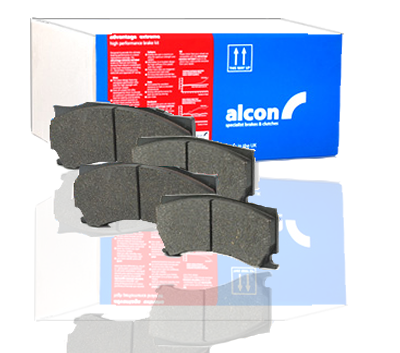
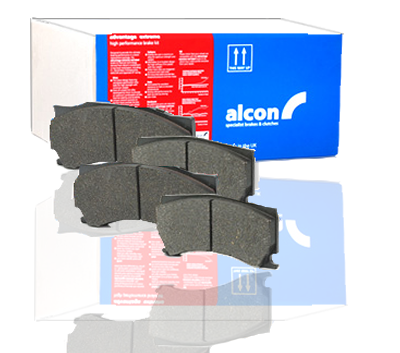
2011-2017 F-550/F-450. This generation uses Alcon's earlier armored mil-spec front kit architecture. Front and rear pad sets are cataloged separately (front PN PNS4415X506.4, rear PN PNS4415X507.4), and there's also a low-wear front pad option (PN PNS0084X492.4) for fleets that prioritize longer service intervals over ultimate bite. Caliper rebuild seal kits for this generation use 48mm seals (PN CSK484848EW761), sold per caliper, which matters when you're budgeting a full rebuild across a four-caliper front axle.
2018+ F-550/F-450. Ford revised the front axle and caliper mounting on this generation, and Alcon's kit follows suit with its own caliper casting and a front-specific armored pad (PN PNS4446X535.4). The Front Big Brake Kit for this generation (PN BKF4659CN02) is the complete front-axle package: calipers, mounting hardware, and rotors sized for the 2018-and-later chassis.
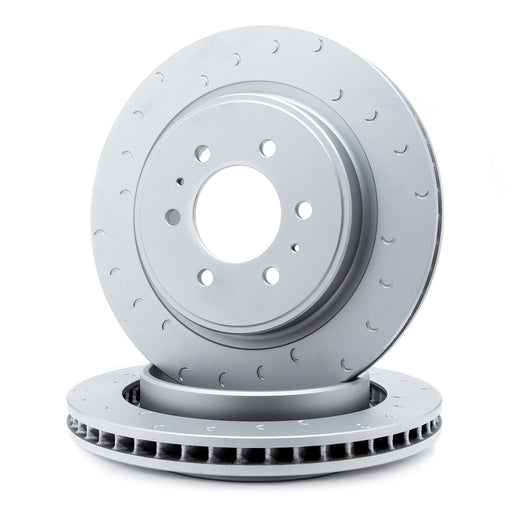
The rotor sizing itself is shared architecture but generation-specific in application. The front rotor kit (PN DIA2222X011PL) is a 393mm x 36mm heavy duty rotor pairing, and it's specified to fit the 2011-2017 F-550/F-450 Alcon kit only, not a universal fit across both generations. The rear rotor kit (PN DIA2222022PR) steps up to a 400mm x 32mm heavy duty rotor and, like the front, is matched to the Alcon kit rather than intended as a stock-caliper replacement.
The practical takeaway: know your build year before you order. A 2016 F-550 and a 2019 F-550 are not interchangeable on calipers, and mixing generations at the rotor or pad level will cost you a return shipment.
Matching Pad Compound to Mission Profile
Alcon's F-550 pad lineup isn't a one-size-fits-all street compound. It's built around the "Armored/OffRoad" driving style filter on the collection for a reason: these vehicles spend real time loaded, at low speed, in stop-and-go convoy or patrol work, and sometimes in sustained descent with a full box on the back.
- Standard armored mil-spec pads (front PN PNS4446X535.4 for 2018+, PN PNS4415X506.4/PNS4415X507.4 for 2011-2017) are the baseline high-temperature compound built for the armored front kit. These are the right call for up-armored law enforcement and government fleet vehicles running consistent heavy loads.
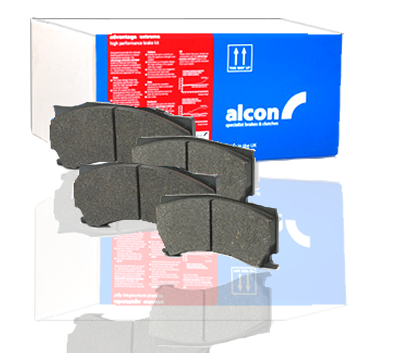
- Low wear front pads (PN PNS0084X492.4, 2011-2017) trade a small amount of initial bite for extended service life. If your F-550 is a patrol or EMS vehicle logging heavy mileage between depot visits, this is worth discussing against a maintenance interval, since it changes how often the truck needs to come off the road for a pad swap.
Neither compound is a track pad, and that's intentional. A race-biased compound needs heat to come into its operating window and can be inconsistent cold, which is the opposite of what you want on a vehicle that spends time idling at a checkpoint before a hard stop is needed.
Rebuild Parts: Don't Overlook the Seal Kit
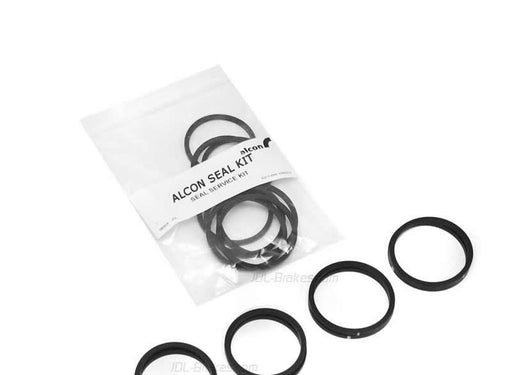
Big brake kits on heavy, low-mileage-per-year fleet vehicles often need caliper seal service before they need new pads, especially on trucks that sit between deployments or spend time in wet or muddy conditions. The 2010-2017 F-550 caliper seal kit (PN CSK484848EW761) uses 48mm seals and is sold per caliper, not as a full-axle set. If you're budgeting a fleet rebuild, multiply by caliper count rather than assuming a single kit covers the axle. This is a common ordering mistake we see from fleet maintenance teams working from a parts list built for a passenger car, where one kit typically does cover an axle.
Best Setup for Common F-550 Use Cases
Best for rural law enforcement patrol trucks: 2018+ Front Big Brake Kit (BKF4659CN02) paired with the 2018+ armored front pad (PNS4446X535.4). Patrol duty means unpredictable hard stops from moderate speed with a consistently loaded vehicle (light bar, push bumper, cage, spare ammunition and gear), so clamp force and thermal margin matter more than outright pad life.
Best for up-armored government and specialist vehicles: Full front rotor and caliper kit matched to chassis year, plus the standard armored mil-spec pad rather than the low-wear option. Armor plating adds mass low and central, which increases braking energy per stop; this is the scenario Alcon's 30,800 lb rating specifically targets.
Best for high-mileage fleet EMS or utility trucks: Low wear front pad (PNS0084X492.4, 2011-2017 chassis) to stretch service intervals, combined with a scheduled caliper seal inspection rather than a reactive one, since these vehicles are harder to pull from service on short notice.
Best for a full rebuild after fluid contamination or a stuck caliper: Order seal kits per caliper (CSK484848EW761 for 2010-2017), not per axle, and inspect rotor thickness against Alcon spec before reusing rotors on a rebuild; a rotor that's been run thin under heavy-vehicle heat cycling won't have the mass left to perform to the original rating.
FAQ
Does the F-550 Alcon kit actually require 30,800 lbs of vehicle weight to make sense?
No. The 30,800 lb figure is the upper support rating, not a minimum threshold. It tells you the ceiling the system is engineered for, which is the relevant number if you're specifying brakes for an armor upfit or a heavy wrecker body where the finished weight is well above the factory F-550 GVWR. A lighter loaded truck still benefits from the added thermal margin, it's simply not being pushed to the top of the kit's capability.
Can I mix a 2018+ caliper with 2011-2017 rotors, or vice versa?
No. The front rotor kit (DIA2222X011PL) is specified to fit the Alcon 2011-2017 F-550/F450 kit only. Caliper mounting and rotor hat geometry changed between generations, so cross-generation mixing isn't a supported fitment, even where bolt patterns might look similar at a glance.
Do I need to replace calipers if I'm just doing a rotor and pad refresh?
Not necessarily, if the calipers are in good condition and matched to your chassis year. Rotors (DIA2222X011PL front, DIA2222022PR rear) and pads are sold separately from the full Front Big Brake Kit specifically so fleets can do a wear-item refresh without replacing the whole caliper assembly.
What's the difference between the standard armored pad and the low wear pad on 2011-2017 trucks?
The standard armored mil-spec pad (PNS4415X506.4 front) is the baseline high-temperature compound for the armored front kit. The low wear pad (PNS0084X492.4) is an optional compound built to extend service intervals, which matters more for fleets tracking cost-per-mile than for vehicles prioritizing maximum initial bite.
How often should caliper seals be inspected on a fleet F-550?
There's no universal mileage number since duty cycle varies so much between a patrol truck and a wrecker, but any vehicle that sits for extended periods between deployments, or operates in wet, salted, or muddy conditions, should have seals inspected on a schedule rather than waiting for a leak to show up during a pre-trip check. Order the seal kit (CSK484848EW761) per caliper when budgeting a rebuild.
Is the rear rotor the same size as the front?
No. The front rotor is 393mm x 36mm (DIA2222X011PL) and the rear is 400mm x 32mm (DIA2222022PR). The rear rotor has a larger diameter but is thinner than the front, reflecting the different heat and load distribution between axles on a heavy front-engine chassis like the F-550.
Have a specific F-550 build in mind, armored, wrecker, ambulance, or fleet patrol? Contact us at (630) 360-2548 or sales@alconkits.com and we'll help match the kit to your chassis year and duty cycle before you order.